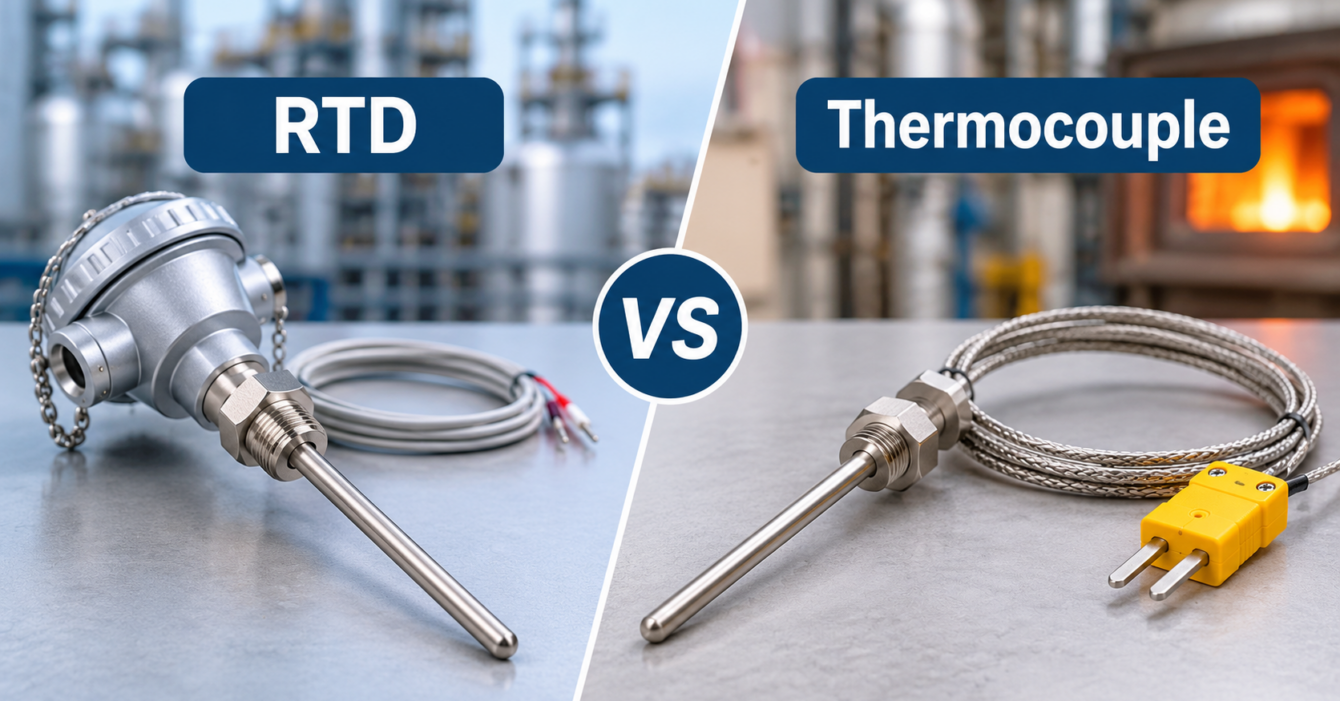
What Are RTDs and How Do They Work?
Temperature measurement is an integral aspect of numerous industrial processes. Knowing and controlling temperature is indeed a crucial task in industry. In this context, we examine two temperature sensing devices viz RTD and thermocouple.
An RTD is a temperature sensor whose resistance varies with temperature. It is a passive device that is known for its high accuracy and long-term stability. RTDs are commonly used in several applications, including automotive, white goods, marine, and process industry.
Working
‘As the temperature of a metal increases, so does its resistance to the flow of electricity.’
This basic principle of physics is at the heart of the operation of an RTD, which essentially comprises a resistance element – usually platinum – and insulated copper wires. A small electrical current is passed through the element, and the resulting resistance is measured. This measured value is compared with calibration data and a temperature controller converts it into an actual temperature read out.
What Is a Thermocouple and How Does It Work?
A thermocouple is a temperature sensor made from two different types of metals, joined together at one end to form a measuring junction.
Thermocouples are commonly used in wide-ranging applications, including factory automation, process control, scientific & lab equipment, medical instruments, military systems, and household devices.
Working
The Seebeck Effect is a phenomenon that states: When a pair of dissimilar metals in contact with each other at each end is subjected to changes in temperature, they create a small voltage potential.
It is this underlying principle that governs the operation of a thermocouple. The voltage produced depends on the temperature difference between the measuring junction (hot junction) and the reference junction (cold junction). By measuring this voltage, an instrument can calculate the temperature at the measuring point.
RTD vs Thermocouple: Key Differences
The following are the key points of difference between an RTD and a thermocouple:
- RTDs typically operate in the temperature range of -200°C to 600°C whereas thermocouples are ideally suited for a range of -270°C to 2,300°C
- RTDs are preferred for their exceptionally high precision whereas thermocouples have moderate to low accuracy
- RTDs have a slower response time, while thermocouples are relatively faster
- RTDs are fragile by design, whereas thermocouples are robust and can withstand physical shock or vibration
- RTDs are expensive, whereas thermocouples are cost-effective, especially for high-volume installations
Which Temperature Sensor Is Best for Different Applications?
Owing to their characteristics and features, both RTDs and thermocouples have their own set of applications.
RTDs are ideally suited for use in laboratory environments and calibration checks, vaccine storage units/cold rooms, HVAC systems, and mission-critical industrial processes.
On the other hand, thermocouple sensors are extensively used in heavy industry, high-temperature furnaces, jet engines, and combustion and exhaust monitoring.
RTD or Thermocouple: How to Choose the Right Sensor?
Different demands and requirements dictate the decision to choose the ideal sensor.
Opt for an RTD when temperatures are moderate and you need high precision and greater stability. Go for a thermocouple when you seek fast response times, budget is a concern, the operating environment is underlined by extreme heat, and site conditions are harsh.
FAQs
RTDs are known for their high precision and accuracy.
A thermocouple has a faster response time.
Actually, the choice depends on several aspects. RTDs are preferred in industrial scenarios where accuracy and stability are paramount, whereas when response time, cost, and rugged operating environments are the driving factors, thermocouples are the best choice.
Thermocouples, which have an extensive operating range of -270°C to 2,300°C, are better suited for high-temperature applications.
Yes, they can indeed be used in the same application.
RTDs typically last from 5 to 15 years. However, thermocouples, which are comparatively less durable, last anywhere from a few months to several years; 3 to 5 years in most practical cases.