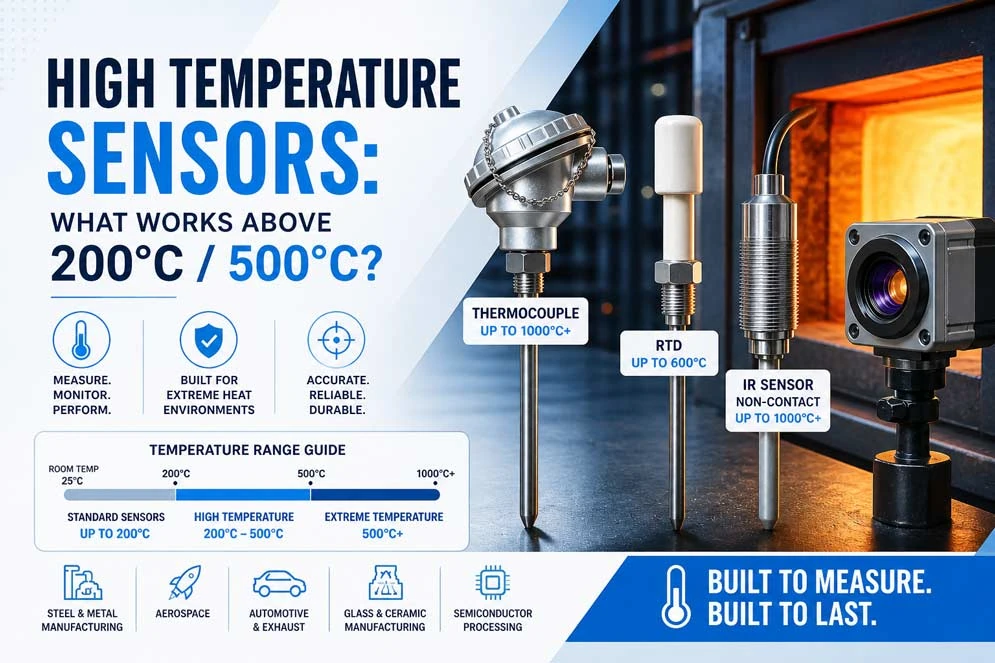
Not all sensors are designed to work in heat. When standard temperature probes are pushed too far, they break rapidly. In industrial settings, this doesn’t only imply a wrong reading; it also entails downtime, safety issues, and costly repairs. This tutorial from Purn Sanket Electrols (HK Brand) explains which high temperature sensors function at very high and very low temperatures and why it’s important to choose the right one.
Key Takeaways
- In the industry, "high temperature" begins at 200°C. For procedures exceeding 500°C or 1000°C, you need specific kinds of thermocouples.
- Type K is the most common high-temperature sensor that works in oxidizing environments up to 1000°C (short-term 1200°C).
- Type S, R, and B thermocouples are only used in furnaces, smelting, and glass lines that are over 1000°C.
- The kind of protection tube material (SS, alumina, ceramic) is just as important as the type of thermocouple.
- Always use the right thermocouple grade for the kind of environment (oxidizing, reducing, inert, or vacuum)
What "High Temp" Means in Industry
The term “high temp sensor” is relative since what is considered “high temperature” differs by industry. Here’s a useful breakdown:
| Temperature Band | Typical Applications |
|---|---|
| 200°C - 500°C | Ovens, HVAC ducts, hot water systems, plastics processing |
| 500°C - 1000°C | Heat treatment furnaces, kilns, boilers, and forging lines |
| 1000°C - 1800°C | Glass furnaces, smelting, incineration, ceramic firing |
Standard RTDs (PT100) and Type T or J thermocouples work well for measuring below 200°C. After that point, you need a high-temperature thermocouple that has been created just for that purpose. The selection tree branches out considerably from 500°C and higher.
Thermocouple Options for High Heat
The wire alloy pair in each thermocouple type determines its usable temperature range and suggested environment.
- Type J (Iron-Constantan): 0 to 400 degrees Celsius. Suits lowering and stable atmospheres. Iron oxidizes when it becomes hotter than 760°C; thus, it can't be used for long periods of time at high temperatures.
- Type K (Nickel-Chromium / Nickel-Alumel): 0–1000°C for a long time, up to 1200°C for a short time. The most common kind of thermocouple sensor used in business, it works well in both oxidizing and inert conditions.
- Type S (Platinum-Rhodium 10%): 1300°C for longer durations, 1600°C for a short duration. Used in lab kilns and precision furnaces. Needs to be safe against gases that lower its temperature.
- Type R (Platinum-Rhodium 13%): This type has a range that is similar to Type S, but its thermoelectric output is about 15% greater. Only works in oxidizing environments.
- Type B (Platinum-Rhodium 30%): 200–1800°C for a long time, and 1850°C for a short time. The maximum temperature that all typical thermocouples can handle. At room temperature, the output is almost zero; there is no need for a correction wire.
In most Indian factories, Type K furnaces, heat treatment, and boilers provide 80% of the needs. Types S, R, and B are only for the hottest environments.
Probe Build Materials + Protection
Without the correct wrapping, a thermocouple wire by itself won’t last in really hot conditions. The protective tube, also called the thermowell, is what keeps the sensing element safe from the hostile process environment.
- Stainless Steel (SS 304/316): Good up to around 900°C. Affordable, easy to get, and good enough for most heat exchanger and boiler uses. Resistant to corrosion in moderate chemical conditions.
- Inconel / High-Nickel Alloys: Work well at temperatures between 900°C and 1100°C. In cyclic temperature settings like heat treatment furnaces, it resists oxidation better than regular SS.
- Alumina Ceramic (95%-99.5% purity): Can be used at temperatures up to 1700°C. Used in glass furnaces, ceramic kilns, and smelting processes where metal tubes would melt or make the melt dirty.
- Silicon Nitride Ceramic: Great at handling thermal shock and performing well at high temperatures. It's best for uses that include quick temperature changes or abrasive materials.
- Mineral-Insulated (MI) Cable: The thermocouple wires are packed in magnesia powder within a metal outer sheath. This makes the cable strong and able to tolerate conditions with a lot of vibration.
Purn Sanket Electrols makes HK Brand thermocouple sensors with sheath materials and connecting heads that can be changed to fit your individual process needs.
Use-Case Mapping
Matching the right sensor to the application prevents premature failure and measurement drift.
| Application | Recommended Type | Sheath Material |
|---|---|---|
| Industrial ovens (200-500°C) | Type J or Type K | SS 304 |
| Heat treatment furnaces (500-1000°C) | Type K | SS 316 / Inconel |
| Ceramic / glass kilns (1000-1600°C) | Type S or Type R | Alumina ceramic |
| Smelting/incineration (>1600°C) | Type B | Silicon nitride ceramic |
| Boilers/process steam lines | Type K | SS 316 with thermowell |
| Plastic extrusion/moulding | Type J or Type K | SS 304 with compression fitting |
If the sensor will be subjected to both heat and vibration, such as in rotary kilns or forging presses, mineral-insulated assemblies with ceramic-insulated heads are highly suggested.
Frequently Asked Questions
What is the most commonly used high-temperature thermocouple in the Indian industry?
For most industrial uses up to 1000°C, type K is the best option. It has a wide range, is cost-effective, and works with most process controllers and displays that are available in India.
Can I use a standard stainless steel thermocouple above 1000°C?
No. Stainless steel sheaths can only go up to around 900°C. You also require high-alumina ceramic or silicon nitride protective tubes to keep the sheath from breaking and the sensor element from becoming dirty.
What's the difference between Type S and Type B thermocouples?
Type S can be utilized up to 1600°C, but it needs cold-junction correction. Type B works up to 1800°C and has very little output at normal temperature, so it doesn’t require a correction wire. This makes it easier to use in very high-temperature settings.
How do I know which thermocouple suits my atmosphere?
Types K and N are good for environments that oxidize. Type J works well in situations that are inert or that are becoming smaller. Precious metal kinds (S, R, B) are needed for situations with a vacuum or a mix of gases. Always talk to a sensor expert before using them in situations where the method isn’t clear.