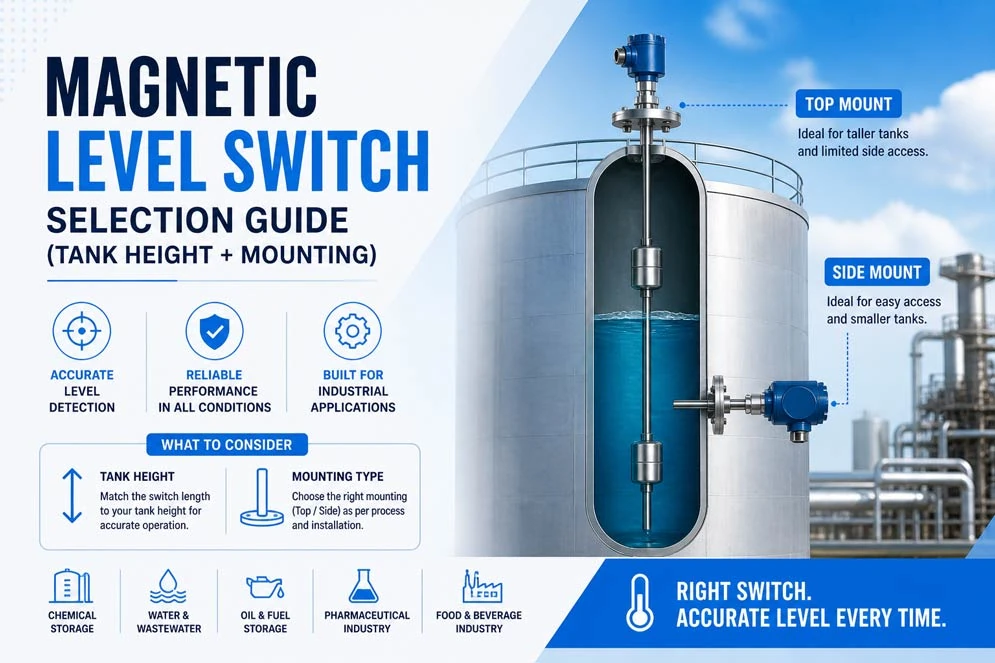
It’s not enough to merely choose a magnetic level switch off the shelf for your tank. Even a little difference in stem length or mounting type might cause the pump to malfunction, overflow, or run dry and cause damage. We at Purn Sanket Electrols (HK Brand) have put together this guide to help you choose with confidence by explaining all the important factors.
Key Takeaways:
- The stem length must fit the height of your tank. If it's too short, it won't be able to detect anything, and if it's too long, it might break down.
- Different tank shapes work well with top, bottom, and side installation.
- The kind of material (PP, SS, or Nylon) used relies on how well it works with the liquid.
- The wiring output (NO/NC, relay, controller) must work with your alarm or automation system.
- Before you make your final decision on a float level sensor, always check the specific gravity and temperature.
Where Magnetic Level Switches Are Used
A magnetic float level switch has a magnet within a float that stays on the surface of the liquid. As the level goes up or down, the magnet turns on a hermetically sealed reed switch within the stem. This means that the detector itself doesn’t need any outside power to work.
These devices are used in a lot of different businesses and industries:
- Water and wastewater treatment: Pump control, overflow prevention, reservoir management
- Chemical and pharmaceutical processing: Tight level control with corrosion-resistant builds
- HVAC and refrigeration: Condensate pan monitoring, coolant level detection
- Food and beverage production: Hygienic liquid management in storage and processing tanks
- Oil, fuel, and hydraulic tanks: Level alerting in storage and machinery systems
- Boilers and cooling towers: High-Temperature Compatible Options with Integrated High Temperature Sensors for Process Plants.
The float level switch is the most popular option in Indian OEM and process industries since it is simple and reliable, with minimal moving parts.
Mounting Types + Sizing Stem Length
One of the first things to think about is how to mount it, which is directly related to the shape of your tank and where you can get to it.
| Mounting Type | Best For | Stem Orientation |
|---|---|---|
| Top mounting | Deep tanks, sumps, process vessels | Vertical, stem hangs downward |
| Side mounting | Tanks with limited top access | Horizontal, float moves laterally |
| Bottom mounting | High-level detection/alarm | Vertical, stem points upward |
The stem length has to be the right size for your tank height and the detection point (high, low, or mid-level). A stem length of around 450 to 500 mm is normal for a tank that is 600 mm deep and needs a low-level cutoff 100 mm from the base. Always take the dead band (float travel zone) out of the useful depth of your tank. If you need to detect multiple points, think about using multiple floats on a single stem.
Material Compatibility
The float body, stem, and cable jacket all need to work with the liquid being monitored. Choosing the wrong materials is the most typical reason why switches fail prematurely.
- Polypropylene (PP): Suitable for water, mild acids, general-purpose liquids
- Nylon / Polyamide: Good for oils, fuels, and low-to-moderate chemical exposure
- Stainless Steel (SS 304/316): Required for aggressive chemicals, food contact, high-temperature fluids
Standard magnetic float level switches don’t work with liquids that leave sediment, scaling, or viscous deposits on the float stem. This buildup stops the float from moving and causes the switch to flip incorrectly. In these situations, a side-mount or guided-float option is better.
Wiring Outputs (Switch / Relay / Controller)
Depending on your control system, you can connect a float level sensor in a number of ways:
- Normally Open (NO / Form A): Circuit completes when liquid reaches the switch point; used for pump-start or fill-valve triggers
- Normally Closed (NC / Form B): Circuit breaks at setpoint; used for high-level alarms and pump cutoffs
- Relay output: Allows the switch to directly drive higher-current loads like motors or solenoid valves
- Controller interface: For PLC/SCADA integration, the switch signal feeds into a level controller, enabling proportional or multi-setpoint control
Make sure that the voltage and wattage of the switch match the load every time. If the switching contacts are too small, they will arc and fail too soon. If they are too big, they may not react correctly to low-power signals.
Frequently Asked Questions
What stem length should I select for my tank?
Measure the distance from the mounting point to the lowest detection level required, then add 50–80 mm clearance. Sanket Controls’ team can help specify exact stem lengths for your application.
Can a magnetic level switch be used in corrosive liquids?
Yes, select SS 316 body switches for strong acids, alkalis, or chlorinated fluids. Always confirm with a suitability chart or request a material sample test before deployment.
What is the difference between NO and NC wiring?
Normally Open (NO) closes the circuit when liquid is present; Normally Closed (NC) opens it. Your choice depends on whether you want the load to activate or deactivate at the setpoint.
Are magnetic float level switches suitable for high-temperature applications?
Standard PP floats are rated up to ~80°C. For steam lines, boilers, or high-temp process tanks, stainless steel body switches with appropriate cable ratings are required.
Find the Right Switch for Your Tank
Since the 1990s, Purn Sanket Electrols has been making HK Brand magnetic float level switches in Mumbai. These switches are used by OEMs and engineering businesses all across India to provide precise sensing solutions. You can go through the whole selection of magnetic float level switches, or you can get in touch with the team personally to get a suggestion that fits your tank’s needs.
Contact Us Now