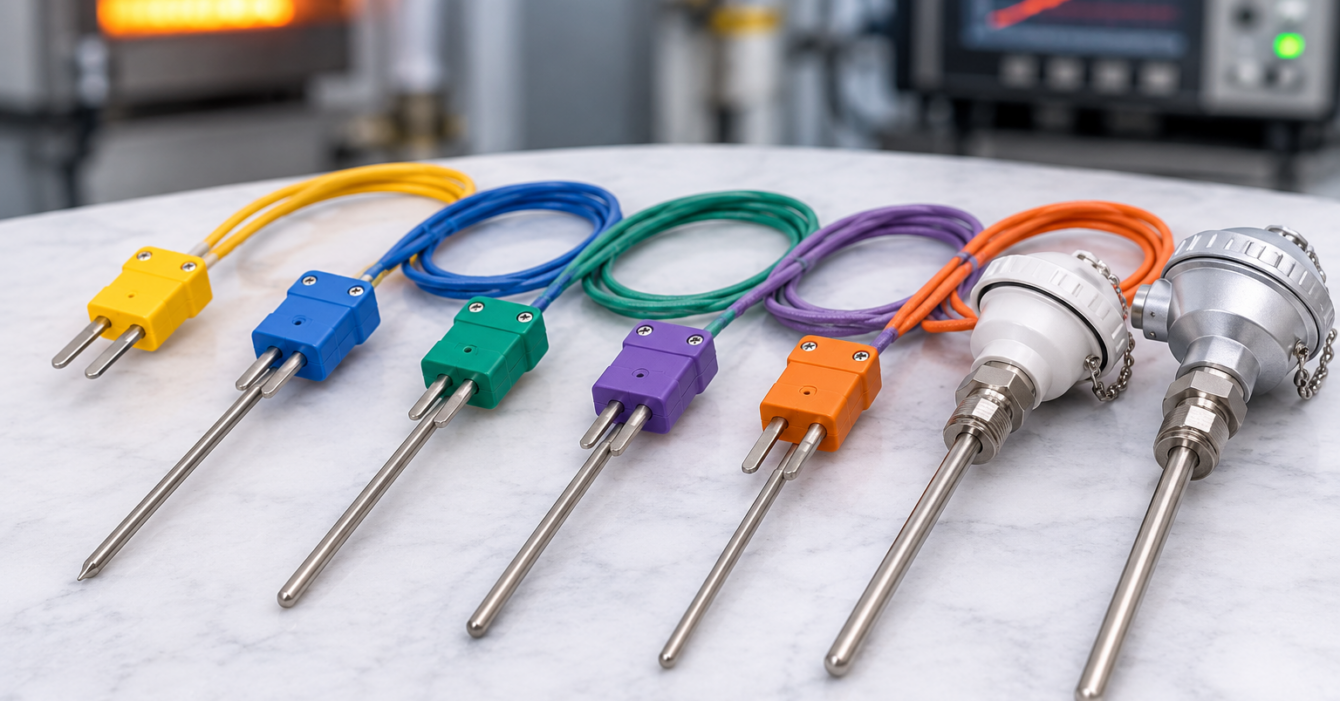
What Is a Thermocouple and How Does It Work?
A thermocouple is a temperature sensor made from two different types of metals, joined together at one end to form a measuring junction.
Thermocouples are commonly used in wide-ranging applications, including factory automation, process control, scientific & lab equipment, medical instruments, military systems, and household devices.
The Seebeck Effect is a phenomenon that states: When a pair of dissimilar metals in contact with each other at each end is subjected to changes in temperature, they create a small voltage potential.
It is this underlying principle that governs the operation of a thermocouple. The voltage produced depends on the temperature difference between the measuring junction (hot junction) and the reference junction (cold junction). By measuring this voltage, an instrument can calculate the temperature at the measuring point.
What Are the Different Types of Thermocouples?
All thermocouples sensors operate on the same basic scientific principle, i.e. the Seebeck Effect. Nevertheless, depending on the differences in their materials, design, production technology, etc., they are categorised into various types.
Following are the different types of thermocouples in practice:
K Type
This is the most commonly used thermocouple with a wide-ranging industrial application in industry. It is made from Chromel (nickel-Chromium) and Alumel (Nickel-Aluminum) wires.
Key Highlights
- Widest operating range – from -328°F to 2,300°F
- Stable and highly reliably in oxidizing, inert, and dry atmospheres
- Superior sensitivity makes it best suited for precise temperature control
- Commonly used in annealing, carburizing, hardening, and tempering processes
J Type
Made from an Iron and a Constantan conductor pair, it is the second most common type of thermocouple that performs quite well in dry/non-humid conditions.
Key Highlights
- Moderate operating range – Works reliably in the temperature range from -210°C to 750°C
- Suitable for use in vacuum, air reducing, or oxidizing atmospheres
- The cheapest, most economical among all types of thermocouples
- Commonly used in industrial furnaces and ovens as well as plastic machinery, rubber moulding, and general plant maintenance
T Type
Made from Copper and Constantan, it is known for its excellent accuracy at low temperatures.
Key Highlights
- Lower operating range – from -250°C to 350°C
- Works well in oxidizing, reducing, and moist environments
- High precision with excellent repeatability
- Widely used in laboratories, research establishments, food processing industry, and space missions; best suited for ultra low-temperature applications, such as cryogenics and freezers
E Type
Comprising a Positive Leg made of Chromel (Nickel-Chromium alloy) and a Negative Leg made of Constantan (Copper-Nickel alloy), the E Type thermocouple is known for its excellent accuracy in medium temperature ranges.
Key Highlights
- Extensive operating range – from -270°C to 870°C
- High signal sensitivity
- Ideally suited for environments with strong magnetic fields and inert atmospheres
- Preferred in power plants, nuclear applications, and cryogenic research
N Type
Made from Nicrosil (Nickel-Chromium-Silicon) and Nisil (Nickel-Silicon) alloys, the N Type thermocouple offers good stability and accuracy over a wide temperature range.
Key Highlights
- Excellent operating range – Operates continuously from roughly 0°C to 1150°C; short term stability when used down to -270°C or up to 1300°C
- Superior thermal stability and repeatability between 300°C and 500°C
- Ideally suited for precise measurements in challenging and high-temperature industrial environments
- Widely used in the heat treatment, aerospace, and power generation sectors
R Type
Made from Platinum-13% Rhodium (Positive Leg) and Pure Platinum (Negative Leg), the R Type thermocouple is a noble-metal temperature sensor that finds application in very high temperature environments.
Key Highlights
- Superior operating range – Continuous working in the 0°C to 1600°C range
- High accuracy and stability
- Quite expensive
- It’s the choice of thermocouple for industrial furnaces and kilns as well as the glass, steel, petrochemical, and semiconductor industries
S Type
It’s a noble-metal sensor composed of Platinum-10% Rhodium and pure Platinum, ideally suited for measuring temperature in a wide variety of environments.
Key Highlights
- Extensive operating range – 0°C to 1,600°C (continuous performance)
- High stability and tight tolerance
- Longer service life
- Widely used in glass furnaces, heat treatment plants, ceramic kilns, and petrochemical facilities
How to Choose the Right Type of Thermocouple?
Choosing the right type of thermocouple depends on studying and understanding multiple factors, such as temperature range, environment, junction style, material type, response time, and economic advantages.
FAQs
The Type K thermocouple.
Type K is best suited for high temperatures, oxidizing or inert atmospheres, aerospace, gas turbines, and general industrial use above 750°C whereas Type J is ideal for moderate temperatures, vacuum, reducing/inert environments, and plastic or general industrial processing below 750°C.
The Type R thermocouple.
3 to 10 years in a standard residential environment and 6 months to 5 years in a highly demanding industrial ecosystem.